Posted on

C to Sea

It’s the strange things you missed during the Covid-19 lockdown. Mine was not plentiful supplies of pasta or toilet roll or the ability to go out for a beer but the sea.

Living in Chesterfield, we’re nearly as far away from the coast as you can get. On a good day it’s 90 minutes drive or around 5 hours by bike.

A few years ago I did the Dunwich Dynamo. A fantastic event that runs every July from London Fields in Hackney to the small hamlet of Dunwich. There’s no organisation as such, just turn up and ride for free.

Everyone picks their own pace and is self sufficient either taking food with them or stopping on their way. There’s no leader, no big pack, just roll along as you like through the night.

When I did it I thought wouldn’t it be great to do something from Chesterfield to the coast. One of my fave spots on the edge of the North Sea is Kilnsea outside of Hull. This made a logical destination. There’s not a lot there apart from a World War One fort that’s crumbling away and a caravan park, but to get to it gives the opportunity to ride over the Humber Bridge.

The plan is when life returns to whatever normal, to set off from the Market Pub in Chesterfield around eight and ride through the night to the coast. The adventure won’t be guided – you’ll choose your own pace and route and have to be self sufficient including getting back at the end.

Once the pandemic’s died down I’ll pick a date when I’m riding it and you’re more than welcome to join me for a pint at the beginning and then make your own way. One request though, make sure you’ve got a set of lights and leave your sounds system at home if you’ve got one – my two big bug bears from the Dynamo !

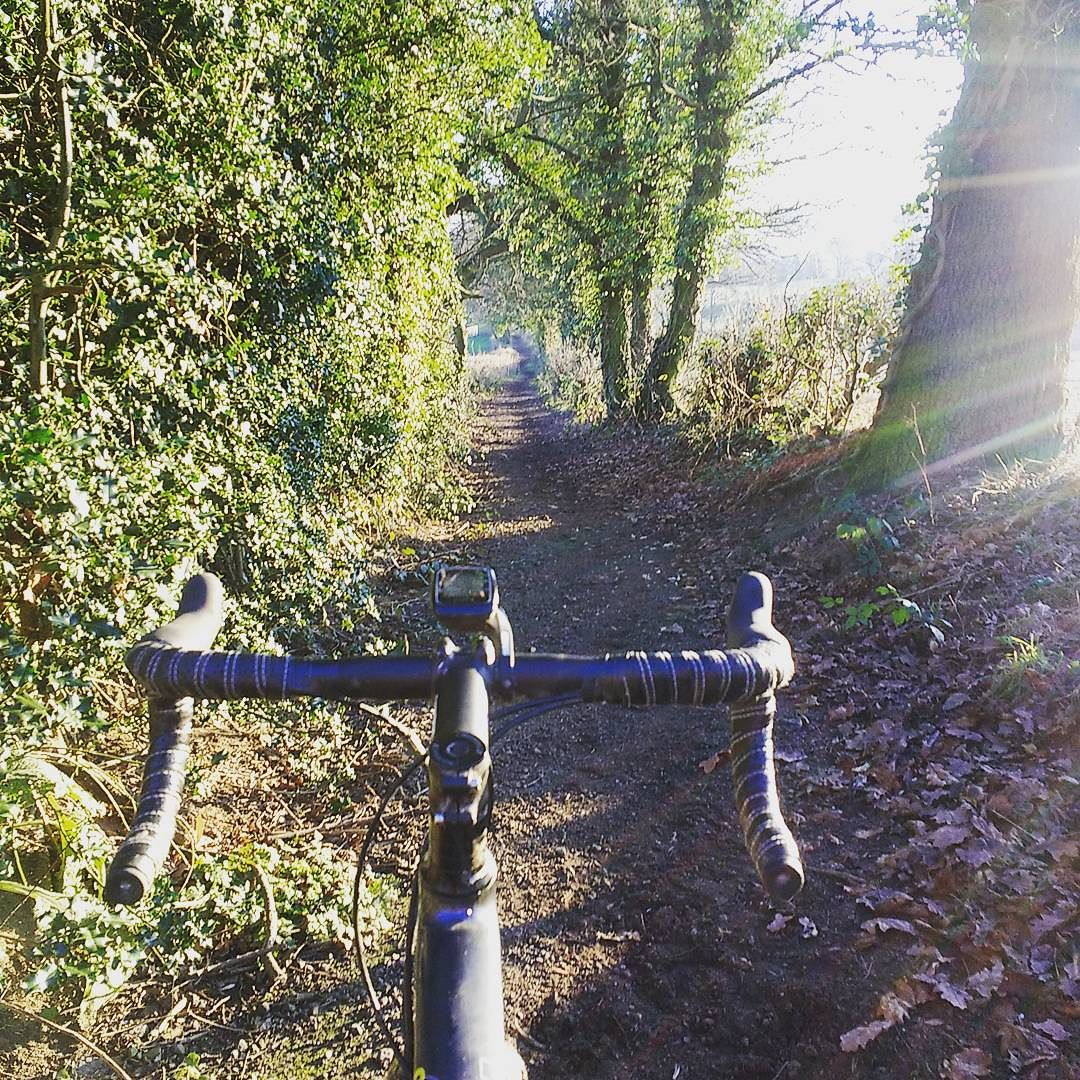
The on/ off route that’s suitable for gravelly type bikes I’ll roughly be following is below. Feel free to choose your own.

Footnote

Since writing this post, due to a number of tragic deaths at the Humber Bridge, access to leisure cyclists is limited to 5am to 9pm. Until access changes, unfortunately this will probably be a daylight route only.

Like what we do ? Why not buy us a coffee !?

Posted on

Solstice Challenge

Bollocks. In front of me there was a flooded bridge. It’s outline marked out by fence posts. The question was, was it complete. The surrounding river looked deep and cold. Should I risk riding it, not knowing the condition of the submerged structure or may an 8 mile detour via the road to Snaith. The clock was ticking on the challenge I’d set myself and I erred on the side of caution and headed back down the road.

Winter is a hard time to get motivated. The nights are long. The days (especially this year ) cold, wet and windy and the warmth of being indoors seductively attractive. I needed to do something to get out of the routine of doing nothing. With the shortest day approaching my mind drifted to the Summer solstice and rides through the night celebrating this. Why not do the opposite and see how far I could ride in the daylight hours around the solstice.

I’d got roughly seven and a half hours to play with and I wanted to get to a destination with a reasonable train service back home. The choice was narrowed down to either York or Cleethorpes off road – roughly 130 km. York won as the train fare was cheapest.

The route I’d chosen was roughly following the Transpennine Trail as far as Selby and then taking the cycle network up to York. I’d ridden bits of the route before so had a good idea what to expect – a mix of trails, quieter roads and bridleways, so my gravel bike was an obvious choice.

I took a pair of trousers and a duvet jacket with me for when I arrived in York as I knew it was going to get dirty out there. I used my Roadrunner Wedgie frame pack to carry sandwiches and other essentials including tools and inner tube.

The first start of the trip was the same as my commute to my office, then over to Ulley and past the reservoir that had threatened to breach in the floods of 2007. Then a short, but busy road section before a quieter bridleway over to Conisborough. My great grandfather used to have a farm near the castle there and drive is cattle down to the centre of Sheffield. A task which took several days.

Then along following the Don to Doncaster. This turned out to be one of the highlights of the route. Following the slow meandering river down a wide valley which looked ripe for canoeing.

Then skirting through Doncaster following old railway track beds. Then north past villages that had suffered with the recent flooding. An onto Sykehouse looking out for the familiar red squares of the national cycle network route markers.

All was well until I reached the flooded bridge. After erring on the side of caution I headed the long way round to Snaith. On the way I gave the nod to a cyclist in a vintage Kelme jacket. Only on my return did I discover that this was a fellow I’d been talking to on social media for the past couple of years !

North from Snaith and past a disused airfield that was being used by a gliding club and onto Selby. Once the heart of Yorkshire’s coalfields, this market town’s significance in my journey was it was a major junction. To the east the Transpennine Trail headed towards Howden, to the north the rail trail to York.

No time to hang around as the clock was ticking. On to Riccall and the start of the Solar system trail, with distances being marked by planets.

Past the well healed suburb of Bishopsthorpe and the route was filled with families and dogs barely under control. Whilst the urge to press on was there, I decided the more pragmatic option was to show some patience and proceed with care and a smile.

Finally I was in York, the city seemed very noisy. Full of a toxic mix of Christmas shoppers, tourists and worse for wear revellers. A cyclist started chatting to me whilst we were waiting at a set of lights. ‘Blimey you’re a bit muddy’ he said’ Have you been far ?’. Chesterfield was my reply.

Posted on

GDP uh !

Like most folks we’ve been bombarded over the last few weeks with emails asking if we wanted to stay on mailing lists we never knew we’d been signed up to.

The closer it got to May 25th the more and more desperate the messages got in a nearly pre-apocolyptic frenzy. All of this was due to the dreaded GDPR.

The sharper eyed of the regular visitors to the Velotastic site will have noticed a couple of changes this month. Gone is the mailing list subscription box and added to the list of pages is a privacy policy.

The privacy policy just echoes what we’ve done from day one. The only way we’ll use your information is to ship your order off or to reply to your messages. If you want your details deleting from our site, just give us a shout and we’ll do that with pleasure.

A few years ago we were approached by a short lived show to exhibit with them. They said they would do us a better price if I threw in my customer details. Not surprisingly we didn’t go to that show as it was non of their business.

Regarding the mailing list. Most of our sales come from organic searches, ie people finding us on Google or similar. If we do get any new products or have something to say we either put it on our blog (here) or on our Facebook or Twitter feed. To an extent our mailing list felt like we were regurgitating this information and it was old news. GDPR was the final push to cause us to rest that idea.

We hope you understand why we’ve done these things and where we’re coming from.

ride safe

Paul


Posted on

The Brutal Tootle

We had great fun putting together the route for the Hardcore100 and were chuffed to bits with the feedback we had when we had run the event.

A big thank you to everyone who supported this event and encouraged us at every step.

We enjoyed organising it that much that we’ve decided to put on a sequel event, the Brutal Tootle on September 30th.

Like the Hardcore100 it will be run as a reliability ride with no marshalls or signage. Riders will either navigate using their GPS or a map using a route that will be provided around a week before the start,. The event HQ in Holmesfield will be the same too, but a different route will be used.

Again it will be a big day out using a mix of bridleways, unsurfaced rights of way and country lanes in and around the Peak District. We’re aiming for a mix of on and on road sections and we can guarantee that it will be another big day out with around 100 km and 2000 m plus of climbing.

There are several reasons why we will change the route. This will discourage people from trying to smash it round and set a PB. It will also hopefully reduce the pressure on trails by spreading the load. We’re also limiting numbers like before to 150 riders to limit the impact on the environment.

On the Hardcore100 we tried to encourage people to use the shops and cafe’s in the communities they were passing through and help our local economy. We’re pleased to continue this ethos, with no feed stations, but plenty of tea and cake at the finish.

Whilst this event and the way we do things may not appeal to all we hope it sparks an interest with you.

Keep an eye on our Facebook page for more events.

Posted on

The joy of one….

I’m the first one to admit that I get bored easily. However if I didn’t there would probably be no Velotastic, I’d be doing the same thing I always did and life would be rather dull.

The same goes for my cycling. It would have been so easy just to stick with riding my MTB just like I did in 1986 and not have a crack at road cycling, the track, cross, gravel or numerous other bicycle related disciplines.

One of the things I’ve been wanting to have a go at for a while is single speed cyclocross. This is a chapter of the broad church of cycling that is definitely tucked away in a darkened corner as an outlier.

SSCX as it is known has its followers though. There is an unoffical World Championships in the USA and a European champs which is being held at the cyclocross mecca of Koksidje, Belgium this March.

My aim was to build a bike out of old spares that I had available and minimise my spend. I was not planning on crossing continents or doing anything epic – just blasting round the local woods and trails and having a bit of hoot.

I set myself a budget of whatever I could get for a pair of secondhand SRAM shifters on eBay which turned out to be around £70.

I’ll stick my hand up and admit that I did happen to have an old cyclocross frame complete with old school cantilever brakes and a set of Winter wheels to hand which helped keep my roughly on budget. All I had to buy was a sprocket and spacer set, chain tensioner and a set of cheap levers.

The ride

I’ve already got a singlespeed bike that I use for commuting so I had a rough idea what to expect. I’d worked out roughly how many gear inches I wanted to push using the Bikecalc website and a few internet forums and settled on around 55″ which worked out as 38:19 on the bike. I hadn’t a clue if this would work in the real world, but thought it would be a good starting point.

There is a certain zen like joy from the sound of a quiet single speed drive train. Hitting this sweet spot of cadence and forward motion makes it all worth while. However I had the hills surrounding Chesterfield to spoil this bit of cycling Nirvana.

Initially anything too steep and it felt like you were pedalling squares and either the drivetrain or your body was going to snap. Routes that I’d done time and time before were taking on a new dimension as I had nowhere to go on the gear hunt and the options were dig deep or walk.After a few rides I’d developed a rather crude technique of attacking the bottom of climbs and managing to keep my legs momentum going. I was slowly increasing the severity of the hills and was managing some shorter 1:8 climbs.

The other problem was the other end of the scale  – downhills and flats. The bike initially spinned out at around 25 km/h. I slowly built up my cadence levels and have learned to pedal a bit quicker and have got this up to around 30 km/h on the flat. Especially on road, downhills turned into a massive freewheel complete with a aero tuck to gain the maximum amount of speed.

Because the bikes a bit old school there are no disc brakes – just canti’s which means braking a little bit earlier and that noisy grinding sound when you get grit between your rims and the pads after going through a puddle of mud.

In conclusion

Would I do it again  – definitely yes. In Winter months when the roads and trails are dirty a single speed is a lot easier to keep clean. OK riding single speed does involve modifying your riding style but it also has the benefits of building your leg strength up and increasing your cadence which cannot be a bad thing.

They are also relatively easy to build and once you have the bike built there are less things to go wrong on the bike which is not a bad thing in the cold Winter months when you want to be riding rather than fettling.

Posted on

Hardcore 100

Regular followers of our social media feeds will know that we’ve got a bit of a soft spot for gravel and cyclocross riding. We’ve been riding our local Derbyshire trails on drop bar bikes for a few years now – way before the ‘gravel’ became popular.  It’s good fun and adds a bit of variety to our rides.

We’ve decided to take this one step further and share a few of our local trails with you in the form of Velotastic’s first event – the Hardcore 100.

Faced with a blank piece of paper and a head full of ideas we sat down and had a think about what we wanted the event to be and what we enjoyed.

The first  thing we decided is that we did not want it to be a sportive. These are just not our cup of tea. We wanted an event that would be a bit of an adventure for the riders taking part and not just a case of smashing it round a course following arrows and getting a time and a medal for riding as quick as you can. If you want to race there are plenty of events where you can pin a number on your back but this is not one of them.

The format we decided on was the classic ‘reliability ride’. This dates back to the times when bikes were not that good and the challenge was to see if you could get round a course. They are very similar to an Audax except there is only going to be one checkpoint (mainly for peace of mind for us to see how you are getting on). The ride will be unsupported, so it’ll be up to you to carry a multitool and innertubes as there’s no sag wagon or mechanical support on offer.

There will be no feed stations – we feel that with a lot of events, people turn up, hammer round a route and do not spend any money in the local economy. We would prefer that you chose when and where you wanted to stop and helped out our shops, cafe’s and pubs.

The route will be revealed a couple of days before the event to entrants in the form of a GPX file that can be uploaded to a GPS. It will be a mix of roads, bridleways and byways and is roughly 30% off road. Naturally we would not recommend that you have a go on a skinny tyred racing bike as you’ll probably end up with a long walk. We’ve tried to avoid the main trails as much as possible and chose a  route that can be ridden regardless of the weather. Struggling across a boggy field is not our idea of fun and is also not that good for the environment.

Numbers will be kept down to a maximum of 150 riders. In our opinion this is a decent number to give the event a special feel and also kinder on the trails you’ll be riding on.

A big thanks to everyone who came and rode this event.

Posted on

Wear and Tear

Summer seems to be taking it’s final bow and Autumn is creeping up on us. If you are fortunate enough to own a Winter bike you maybe thinking about digging it out of deep storage for a few months riding.

Now’s a good time not only to give your Winter ride a check over but also to service your best bike so it is ready to ride when you get it out next Spring. That way you will not forget about any little niggles that have developed and will not miss it if you are using your other bike.

Like it or not, if you’ve been lucky enough to get a few miles in this year, your bike will have suffered some wear and tear. It does not matter how much you have looked after it – it will, it’s just a fact of life.

Here’s a few things that we usually encounter in our workshop:

Bearing wear

Bearings are the things that keep your bike going round and are an essential part of a bike regardless of how much you have spent on it. Over a period of time these steel balls will become less than round and harder to spin round. In some key areas this wear will be accelerated by the ingress of dirt and water. This can show itself in a knocking bottom bracket, a notchy headset and lateral play in your wheels.

This component is relatively cheap to replace  – think of it as a consumable and part of the cost of running a bike rather than something that should not go wrong.

Cables

There’s a popular urban myth that cables stretch under normal usage on a bike. They don’t. Just think about it, unless the cable is made of spaghetti or elastic there’s not way you could stretch it just by shifting gear – there’s not enough force in the system. What does happen is that when you’ve had the cables on your brakes or shifters changed, the outer cables bed in which causes the inner cable to become loose. This is why your gear cables normally need the tension adjusting after a few rides.

What does happen though is the inside of the outer cable gets a bit grubby from dirt and a little rust. This can cause the inner cable to drag a bit. This causes your gear shifting to take a little longer or your brakes to become a little bit harder to put on. In extreme cases we’ve seen derailleurs unable to shift because of gunked up cables.

An easy solution and a good way to get that ‘as new’ feeling back in your bike is to change the inner and outer cables at least once a year.

Chains

Chains are a fantastic piece of engineering but unlike cables they do stretch over time. If this is not kept in check it can cause premature wear to other parts of your drivetrain like cassettes and chainrings. The reason for this is chains are made of harder material than gears so a worn chain will slowly grind the softer components to match its profile.

We have a tool that can check chain wear. We also recommend that gear cassettes are replaced every 2-3 chains just to keep moving smoothly. It’s also worth keeping an eye on your chainrings as these can be ground down and in extreme cases cause the chain to skip at the crank end of the drivetrain.

Torque 

It’s always worth checking that any nut’s and bolts that hold things like your brakes, stems, pannier racks and mudguards are tightened to the correct torque. An over tightened bolt can cause a lot of damage on an expensive carbon frame so it’s advisable to use a torque wrench to get things just right. It goes without saying an under tightened fixing could be very dangerous – especially if it is something to do with your steering or braking.

We operate a mobile workshop in the Chesterfield area and all of the above items we would check in a standard service. Not only will it lengthen the lifespan of your bike but it will make it more enjoyable to ride.


Posted on

Ride Fuel – Banana Bread

If you’ve ever been to Australia you’ll know that the staple in many cafe’s is not flapjack but banana bread. Bananas are often used during a ride but with this easy recipe can be turned into something a little more exotic.

Great either cold or toasted, a slice of this is an ideal post ride snack.

You’ll need..

  • 4 bananas – the mushier the better
  • 2 eggs (beaten)
  • 115g butter
  • 115g brown sugar
  • 250g plain flour
  • 1 tsp bicarbonate of soda
  • pinch of salt
  • 1 tsp cinnamon

To make…

  • Heat the oven to 180 degrees
  • Mix the butter and sugar together in a blender
  • Add the eggs and bananas to the mix
  • Stir in the salt, bicarbonate of soda and cinnamon
  • Pour into a 1 lb bread tin lined with grease proof paper
  • Put in the oven and go and clean your bike or drink some coffee for around an hour
  • Check the bread is baked by stabbing it with a knife – if it doesn’t come out clean give it a bit longer
  • Once done leave it to stand for quarter of an hour in the baking tin resisting temptation to dive in
  • Remove from tin, slice and consume either toasted or as is.
Posted on

Kellham Island Urban Cyclocross

Cyclocross is normally associated with being held in a muddy park in the middle of winter and a way for roadies to keep their fitness up during the off season. Run when the days are short and the rain is horizontal it often results in cold hands, dirty bikes and spectators huddled in any sheltered spots they can find.

Urban cycle across is something a bit different. Kelham Island Museum was recently the location for the first round of the Sheffield urban cx series. Taking place across three locations in central Sheffield, the 6 May saw a small group of riders fill every space of the first event to prove themselves on a circuit around an fantastic old industrial setting.

Gone was the need for pit crews and pressure washers. Instead there were cobbles, North Shore sections through buildings and racing round sculptures and exhibits.

We went to take a look to see what it was all about. First thing that has to be noted was the lack of any sort of consistency not only with the bike used but also the background and style of the riders. There was everything on display drop handlebars on cyclocross with drop bars both old and new carbon and steel, hybrids, gravel bikes, mountain bikes, a lot of 29ers, a lot of single speeds … even 6 inches of full-travel front and rear on an old school 26 “inch wheel mountain bike. Outfits range from full on team lycra to jeans and T-shirts even a man in a skirt and the bra top on his stag weekend … of course what do you do on you stag weekend? A cyclocross race of course!

The races were limited to the number of riders that could take part as this was a tight course wooded boardwalk sections inside old factory buildings, cobbled streets, steps lots of concrete, lots of different surfaces, cobbles, wood, polished painted concrete, slabs, plywood, more cobbles in a lot of variety in different places. If it had been wet might of been a different result for many.

The race was split into four categories – Amateur Men, Sport Men, Women’s and Vet’s. Each category had two qualifying races with the fastest six from each leg going through to the final. The riders started 20m away from their bikes a Le mans style start. They then dashed down the cobbles jumping on their bikes and disappearing off to the first corner. Once round that first corner you sneaked around the outside of the main factory building over a short section of Boardwalk to turn back on yourself and then do a sharp right up a steep ramp sleep that took you up to the first floor of the museum building. Once inside you are met with more boardwalk a a couple of rises, a lovely bermered corner, then negotiate a couple of lifts before then you disappeared out of sight from the spectators down some steps and out the back the old buildings return again down along cobbled street to start lap two.

Spectators were treated to some great vantage points out on the old bridge that links the two main buildings that firm Kelham Island Museum. Inside on the upper floor away from the cold wind that was whistling round the site spectators could watch the race as it sped round some pre-fabricated north shore style trackway.

Beer, coffee, sandwiches all available a few steps away in a couple of rather nice cafe’s – a far cry from the groggy old coffee van in the middle of the woods or muddy field in the middle of nowhere.

The racing was fast and furious and despite some of the clothing people were clearly trying and taking this seriously. Like most cyclocross races, the course was very spectator friendly and there were good viewing points around 80% of the course. There also wasn’t much time in between each race and they kept feeding out riders group after group to keep people entertained.

I can’t help but think that the people with the biggest chance of winning are those deliveroo riders, you know the guys with the blue boxes on their bikes racing to deliver food around town probably the best equipped for a course like this.

We caught up with Adam for a few words about why the event had come together and where the others were going to take place. He said the next event would be at Park Hill flats in September and he’s got a venue in mind for a third event.

Personally I think the format has a lot going for it, good entertainment good quality riders, food and beer on tap, central city location, after the kelham island event there was a local peddlers market … that’s peddlers p-e-d-d-l-e-r people selling goods not just bike bits! craft beer, street food, local makers and artisans just round the corner so you could make a day of it turn up at lunch, watch the racing and go on into the evening in the market round the corner sounds too good to be true good way to bring people into an old inner city area.

There was a good feel to the event and no bike snobbery and plenty of smiles from both the spectators and competitors. Rider Anna Lowe summed the course up “”It was just so intense, the whole thing felt like a blur of cobbles, steps, ramps & corners. Such good fun, how often do you get to ride inside a museum? I won’t forget that one in a hurry!”

Posted on

When the circus comes to town.

It’s not very often that a UCI World Tour comes to your home town, but when a stage of the Women’s Tour both starts and finishes there you feel rather lucky.

This year the 4th stage of the Women’s Tour is starting and finishing in Chesterfield. The final details of the route have yet to be confirmed but from what we can gather and with a little bit of local knowledge it looks like it’s going to be a cracker.

The 133 km route could be considered as the race’s Queen stage with over 2300 metres of climbing in the Derbyshire hills. It could also be the deciding stage as it is also the penultimate before the final days racing in London.

There will be 107 riders, from 17 teams including British squads Drops and WNT.

For more information check out the Women’s Tour website.

Posted on

Learning to Fly

Questioning someone’s cycling ability is a bit like questioning someone’s driving or bedroom ability  – you just don’t go there!

However, you sometimes wonder whether you are doing things right and could you do things better.

Earlier this week I had the opportunity to the National Standards Instructor training course for Bikeability. For those not in the know, Bikeability is the 21st century name for Cycling Proficiency.  However, where the old course was sometimes run by enthusiastic parents and normally was restricted to the playground, Bikeability includes exposure to real roads and real traffic and is run by trained professionals.

The course is split into three levels. Level one is playground based and covers the basics, including setting off, stopping and steering.  Level two moves onto the road and covers the outcomes of junctions and road positioning and level three builds on the previous two courses and includes route planning, roundabouts and more advanced junctions.

Well how did I get on after 40 years in the saddle and no previous training?  Being a driver was a help as I had a knowledge of the Highway Code and traffic.  The main thing that myself and the three other trainees took away was road positioning and observation.  Being assertive and “controlling the lane” enables you to communicate where you want to go and what you want to do.  Reflection was another message that was given.  If things don’t go to plan – what can we do differently to avoid that situation in the future.

If you ever get the chance to do the Bikeability course as either a trainee (many local authorities offer level 3 training for free) or doing the instructor training – do it.  It will open your eyes and may get you thinking of cycling in a different way.

Posted on

das Fahrrad | the bicycle | le vélo | la bicicletta | 自転車

Half the fun of building an older bicycle is finding the period correct parts. You can spend hours visiting cycle jumbles and scouring online auction sites looking for what you are after. There is a fair chance that you will start looking overseas for items, especially if you have a bike fitted with parts that are from a manufacturer that has ceased trading such as Mafac or Simplex.

One of the obstacles that many of us have to overcome when buying overseas is the language barrier. Google translate can help so far but is not perfect. This is the problem that Munich based graphic designer Adam Bell came across when he was restoring his Gitane. As a result of these challenges he decided to write a phrase book for cyclists which we are now carrying in our inventory.

das Fahrrad | the bicycle | le vélo | la bicicletta | 自転車 is illustrated by Adam throughout. It is a joy to read not only for those who love bicycles, but also people who have a fascination with foreign languages. Initially done as a small print run of 1000 books and there are around 275 words or phrases included.

On the back of the book, the author has gone onto produce an A3 poster naming all the bike parts.